| Latency and latency variations of home cable vs. (SV-)VDSL vs. G.fast connections | Created: 20.12.2025 08:31 Last modified: 20.12.2025 21:30 |
|
Note: this was (in part) originally posted on Mastodon: https://social.tchncs.de/@PoempelFox/114244625659317288 Have you ever wondered how the latency and latency variations of different home internet connection options compares? Well, at least for MY home internet connections, I can answer that questions, because I have graphs. There are three contenders here:
While of course these results cannot fully be generalized, because there are quite a lot more factors influencing this than just the "last mile" of the connection, the last mile does have a significant impact. And the main trend should hold: Cable is expected to have a worse latency than SV-VDSL, and G.fast will have the lowest latency of them all. FTTH would be even better than G.fast, but I don't have that available. For all of the graphs below, the yellow line shows the average ping to a select server on the internet - more precisely, the one hosting the webpage you're currently reading. The blue shade shows the range between the minimum and the maximum ping. Orange spikes show packet loss. One ping is sent every 5 seconds. 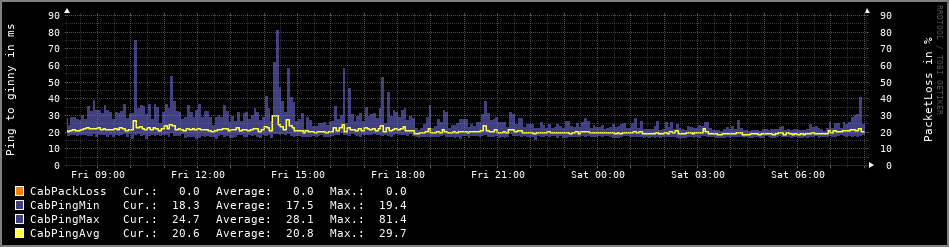 the cable connection 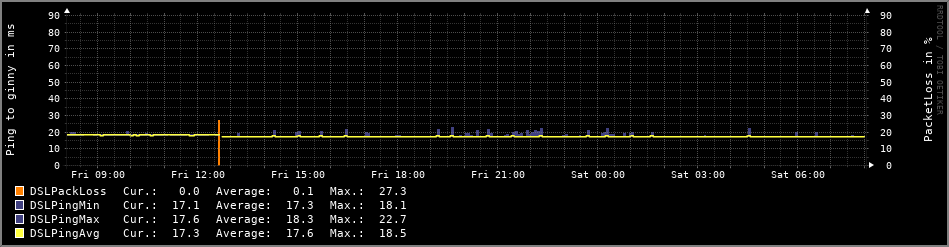 SuperVectoring VDSL 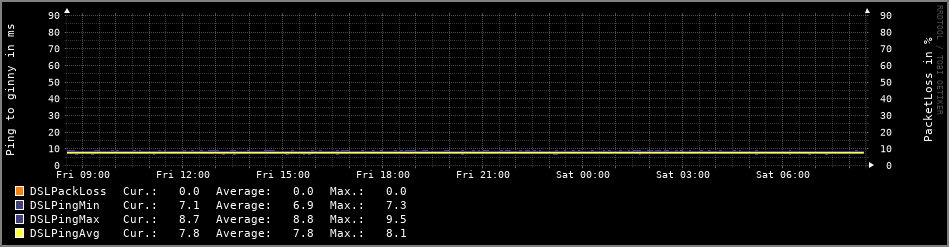 G.fast/FTTB The cable connection is by far the worst of all. While the base latency is fine, the large variations are really not that great. I selected a pretty average day for the graph here - there are days when this is A LOT worse. The main reason for that is probably how the shared medium is handled: The cable modems cannot just send whenever they like, because then there would be collissions. So instead, the CMTS (that is the thing "at the other end" of a cable connection) assigns time-slots to the cable modems, in which they are permitted to send. And depending on how many modems there are in your segment, and how much network usage there currently is, it may take quite some time until your modem gets a slot to transmit your packets. The SV-VDSL has a far more stable latency. The small orange spike is the forced disconnect that this particular ISP does every 24 hours. Apart from that, there is no packet loss - and as you can see, there is not much variation in the latency. And finally, the G.fast connection is the clear winner here. There is not much to see here - the maximum latency variation is about 1 ms, which is pretty much the measurement accuracy. That is despite G.fast doing something that should be bad for latency: While previous DSL variants used different frequency ranges for up- and downstream, so they could be active at the same time, G.fast uses TDD instead, i.e. the whole line alternates between being used as down- and upstream. That of course means your modem cannot immediately send out your data, it needs to wait for the next upstream slot. However, the switch between up- and downstream seems to happen at such a high frequency that this is hardly noticable. (according to some random slides I found online, the length of a 'TDD frame' containing both a period for the down- and the upstream can be configured to between 0.145 and 0.875 ms and defaults to 0.75 ms - but don't quote me on these numbers.) |
|
|
no comments yet write a new comment:
|
|